VA Application Process & Timeline: Step-by-Step Guide
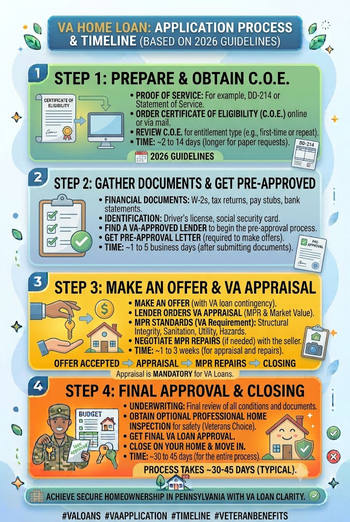 Understanding the VA loan application process will help you prepare for homeownership and know what to expect from start to finish. The process is straightforward, but it involves multiple steps and players. Knowing the timeline will help you plan your move, coordinate with sellers, and avoid surprises.
Overview of VA Loan Timeline
From initial application to closing, a typical VA loan takes 30-45 days. Some loans close faster, while others take longer depending on complexity and how quickly you provide documentation.
Typical timeline: 30-45 days
Fast timeline: 15-30 days (simple loan, quick documentation, no issues)
Slow timeline: 45-60+ days (complex situation, missing documentation, property issues)
Step 1: Pre-Approval (1-3 Days)
What Happens
You contact a VA lender and request a pre-approval. You provide basic information about your income, debts, credit, and the price range you're looking to buy in.
Documentation Required
- Certificate of Eligibility (COE)
- Last 30 days of pay stubs
- Last two years of tax returns
- Last two years of W-2s
- Bank statements (last 2 months)
- List of debts and monthly payments
What You Get
A pre-approval letter stating the maximum amount you can borrow and your interest rate range. This letter is valid for 60-90 days and shows sellers you're a serious buyer.
Timeline
Pre-approval typically takes 1-3 business days, sometimes same-day if you have all documentation ready.
Key Point
Pre-approval doesn't commit you to anything. You can shop around lenders and choose the best rate and terms.
Step 2: Find a Home and Make an Offer (Variable)
Your Role
You work with a real estate agent to find homes in your approved price range, make an offer, and negotiate terms with the seller.
Important for VA Loans
- Appraisal contingency: Your offer should include an appraisal contingency, which allows you to back out if the home doesn't appraise for the full purchase price.
- Financing contingency: Your offer should include a financing contingency, which allows you to back out if you don't qualify for a VA loan.
- Inspection contingency: Include a home inspection contingency to discover issues before closing.
Timing
This step varies widely. Depending on market conditions, inventory levels, and negotiation dynamics, this could take days to weeks.
Pro tip: Contact your VA lender once you have a purchase contract. Don't wait until after the offer is accepted.
Step 3: Formal Loan Application (1-2 Days)
What Happens
Once your offer is accepted, you formally apply for the VA loan with your lender. You'll complete a detailed application (Fannie Mae Form 1003) providing comprehensive financial information.
Documentation Required
Provide all documentation if not already submitted during pre-approval:
- Certificate of Eligibility (original or verified)
- Government-issued ID
- Social Security card
- Last 30 days of pay stubs
- Last two years of W-2s and/or 1099s
- Last two years of complete federal tax returns (all pages)
- Bank statements (minimum 2 months)
- Authorization for IRS verification (Form 4506)
- Verification of Employment letter from employer
- Copy of purchase contract
- Proof of earnest money deposit
- If self-employed: Profit and loss statements, business license
- If rental income: Lease agreements, bank statements showing deposits
- If alimony/child support: Court orders and proof of payment
What the Lender Does
The lender officially processes your application and orders an appraisal.
Timeline
Formal application takes 1-2 business days to process after you submit all documentation.
Step 4: Appraisal Ordered and Completed (5-10 Days)
What Happens
The VA lender orders a professional appraisal of the property. The appraiser inspects the home and determines its market value.
Appraiser's Role
The appraiser inspects the home's exterior and interior, documents any issues or needed repairs, compares the home to similar properties recently sold, determines the property's market value, and ensures the home meets VA standards for safety, sanitation, and security.
Appraisal Cost
Typically $400-$700, paid by the borrower. Usually added to closing costs or rolled into the loan.
Timeline
Appraisal ordering and completion typically take 5-10 business days. In busy markets, it can take longer.
What Can Happen
Property appraises higher than purchase price: Great - you're getting a good deal.
Property appraises equal to purchase price: Normal - the loan proceeds as planned.
Property appraises lower than purchase price: Problem. The loan amount is reduced to the appraised value. You have options: renegotiate the price with the seller, pay the difference in cash, or back out depending on your appraisal contingency.
Repair Requirements
If the appraiser notes needed repairs for safety or sanitation, the lender may require repairs before closing. Common items include roof repairs or replacement, foundation issues, major plumbing or electrical problems, mold or water damage, and pest damage. The seller typically makes these repairs before closing, or you can renegotiate.
Step 5: Underwriting (7-15 Days)
What Happens
A loan underwriter reviews your application in detail, verifying all information and ensuring you meet VA loan requirements.
Underwriter's Role
The underwriter reviews all income documentation, verifies employment history, orders a credit report and reviews it, calculates the debt-to-income ratio, reviews the property appraisal, ensures the loan complies with VA requirements, and identifies any red flags or missing information.
Possible Outcomes
Clear to close: No issues; the loan is approved and ready for closing.
Conditional approval: Approval pending receipt of additional documentation, which is the most common outcome.
Suspended: Significant issues exist and require explanation or additional information.
Denied: Rare, but can happen if major issues exist.
Conditional Approval (Most Common)
Usually, the underwriter will request additional documentation or clarification. Common conditions include updated pay stubs, a letter explaining late payments or collections, verification of a recent job change, additional bank statements, an explanation of recent credit inquiries, updated employment verification, documentation of gifts for a down payment, and an explanation of unusual bank deposits. Most conditional items are resolved quickly (1-3 days) once you provide the requested documentation.
Timeline
Underwriting typically takes 7-15 business days. The timeline depends on how quickly you respond to conditions.
Step 6: Clear to Close (1-3 Days)
What Happens
Once all underwriting conditions are satisfied, the loan receives final approval and is cleared to close.
What Gets Done
- Final verification of employment (day before closing)
- Closing disclosure provided to you
- Final walkthrough of the property
- Closing documents prepared
- Homeowners insurance confirmed
- Property taxes and insurance estimated for escrow
Your Review Period
Federal law requires you receive the Closing Disclosure at least 3 business days before closing. Review it carefully for accuracy.
Timeline
Clear to close to closing typically takes 1-3 days.
Step 7: Closing (1 Day)
What Happens
You sign all final loan documents and the property officially transfers to you.
Where It Happens
Closing typically occurs at a title company office, attorney's office, or lender's office. You, the seller, real estate agents, and a closing agent are typically present.
What You'll Sign
- Promissory note: Your promise to repay the loan
- Deed of trust or mortgage: Gives the lender a lien on the property
- Closing Disclosure: Final loan terms and costs
- Title documents: Deed transferring property ownership to you
- Insurance documents: Proof of homeowners insurance
- Various disclosures: Federal and state required disclosures
Closing Costs
You'll pay closing costs at closing. For VA loans, the VA limits what the lender and seller can charge you. Typical closing costs are 2-5% of the loan amount.
Who typically pays what:
- Lender can charge: Origination fee, appraisal, credit report, title insurance (partial), flood determination, processing/underwriting fees
- Seller typically pays: Real estate agent commissions, seller's portion of title insurance, transfer taxes (in some states)
- You typically pay: VA funding fee, homeowners insurance, property taxes (prorated), HOA fees (prorated), title insurance (your portion)
VA advantage: The VA restricts lender fees and prohibits the seller from charging you certain costs, keeping VA closing costs lower than other loan types.
Funding
The lender sends loan funds to the title company. Once funds are received and all documents are signed, the transaction closes, and the home is yours.
Timeline
Closing takes one day - typically 30-60 minutes for you to review and sign documents.
Step 8: After Closing (1-3 Days)
What Happens
After you sign at closing, the title company records the deed with the county, and funds are distributed.
Your New Mortgage Payment Begins
Your first mortgage payment is typically due 30 days after closing, or as specified in your loan documents.
Your Keys
After closing and funding, you get keys to your new home and can move in.
Complete Timeline Example
Day 1-3: Pre-approval (you apply and lender approves)
Day 4-10: House hunting and making offer
Day 11: Offer accepted
Day 12-13: Formal application submitted
Day 14-23: Appraisal ordered and completed
Day 24-38: Underwriting and conditions submitted/resolved
Day 39: Clear to close received
Day 40-42: Final walkthrough and document preparation
Day 43: Closing
Total time: ~6 weeks from pre-approval to closing
What Slows Down the Process?
Missing Documentation
The biggest cause of delays. Provide everything upfront to avoid back-and-forth requests.
Appraisal Issues
If the home appraises low or the appraiser notes repairs, this delays closing while you renegotiate or arrange repairs.
Title Issues
If the property has title problems like liens, claims, or unclear ownership, these must be resolved before closing.
Slow Seller Cooperation
If the seller is slow to cooperate with appraisal, inspections, or repairs, this delays the process.
Underwriting Issues
If you have credit problems, recent job changes, or income verification issues, underwriting takes longer.
Busy Market
In high-volume lending periods, appraisers and underwriters are backed up, extending timelines by 5-10 days.
How to Speed Up the Process
1. Be Organized
Gather all documentation upfront. Don't wait to be asked. Provide everything during application.
2. Respond Quickly to Lender Requests
When the lender asks for information or documents, respond within 24 hours if possible.
3. Be Proactive on Appraisal
Once the appraisal is ordered, make yourself available for the appraiser. Quick appraisal completion speeds up the entire process.
4. Coordinate with Your Real Estate Agent
Keep your agent informed of your lender's progress and timeline. This helps coordinate with the seller.
5. Review Documents Immediately
Don't delay reviewing underwriting requests or closing disclosures. Quick turnaround speeds everything up.
6. Schedule Closing Early
Once you get clear to close, schedule closing immediately. Don't wait.
VA Loan Timeline vs. Other Loans
| Loan Type | Typical Timeline | Appraisal Required | Key Difference |
|---|---|---|---|
| VA Loan | 30-45 days | Yes | Streamlined; no appraisal contingency usually |
| FHA Loan | 30-45 days | Yes | Similar to VA; more strict appraisal |
| Conventional Loan | 35-50 days | Yes | Longer underwriting; stricter approval |
| USDA Loan | 35-50 days | Yes | More complex property verification |
Key Takeaways
- VA loan timeline is 30-45 days. Fast loans close in 15-30 days; complex ones take 45-60+ days.
- Pre-approval takes 1-3 days. Get this first before house hunting.
- Appraisal takes 5-10 days. This is often the longest single step.
- Underwriting takes 7-15 days. Most delays occur here due to missing documentation or conditions.
- Clear to close happens 1-3 days before closing. This is final approval; you're almost done.
- Appraisal low? You'll need to renegotiate, pay the difference, or back out if your appraisal contingency applies.
- Underwriting conditions are normal. Most lenders issue conditional approvals; conditions are usually easy to satisfy.
- Organization speeds up the process. Provide all documentation upfront; respond quickly to requests.
- You need 3 days after Closing Disclosure. Federal law requires 3 business days for you to review before signing.
- Closing is one day. Takes 30-60 minutes to sign documents.
Understanding Your Application Status
Throughout the VA loan process, you'll check your application status frequently. When you see what does it mean if my application is in process, it means the lender is actively reviewing your file. This status typically appears after you submit your formal application and continues through underwriting. The lender is verifying your documents, ordering the appraisal, and working through conditions.
When your status changes to what does application status decided mean, it indicates the underwriter has made a final determination on your loan. This usually results in clear-to-close approval, conditional approval, or denial. This status is the culmination of the underwriting review.
You'll notice fields for what does start date and end date mean on an application. The start date is when you formally submitted your application. The end date is the estimated closing date or the date the application status reached a final decision. These dates help you track the VA loan process timeline and plan your move accordingly.
When you're in the thick of underwriting, understanding what does an in process application mean is helpful. It signifies your file is actively being worked on. The underwriter may request additional documentation, or the lender might be waiting for the appraisal report. This status means the process is moving forward, just not yet complete.
Bottom Line
The VA loan application process is straightforward but involves multiple steps and can take 30-45 days from application to closing. Understanding each step and what to expect will reduce stress and help you prepare. The key to a smooth, fast process is staying organized, providing documentation up front, and responding quickly to lenders' requests. Most delays happen because borrowers don't provide complete documentation or are slow to respond to lender conditions. By being proactive and organized, you can often close faster than the typical 45-day timeline.
Frequently Asked Questions
What does it mean if my application is in process?
This means the lender has received your formal application and is actively reviewing it. The underwriter is verifying your documentation, checking your credit, and ordering the appraisal. During this time, the VA loan process timeline is moving forward, and you may receive requests for additional information.
How long does the VA loan process take from start to finish?
The typical VA loan process timeline is 30-45 days from application to closing. Some loans can close in as few as 15-30 days if documentation is complete and there are no issues. Complex situations with appraisal problems or title issues can extend the timeline to 60 days or more.
What does application status decided mean on my VA loan?
When your status changes to "decided," the underwriter has made a final determination on your loan application. This usually results in clear-to-close approval, conditional approval with items to be satisfied, or denial. This status typically appears near the end of the underwriting phase.
What do start date and end date mean on an application?
The start date is when you formally submitted your VA loan application. The end date is the estimated closing date or the date the application reached a final decision. These dates help you track the VA loan process timeline and coordinate your move with sellers.
What does an in process application mean during underwriting?
During underwriting, an in process application means the underwriter is working through your file. This could involve verifying income, reviewing the appraisal, or requesting additional documentation. Your application remains in process until all conditions are satisfied and the loan receives clear to close status.
Connect With Us
Please share – it really helps