Student Loan Guidelines for VA Loans: How Student Debt Affects Approval
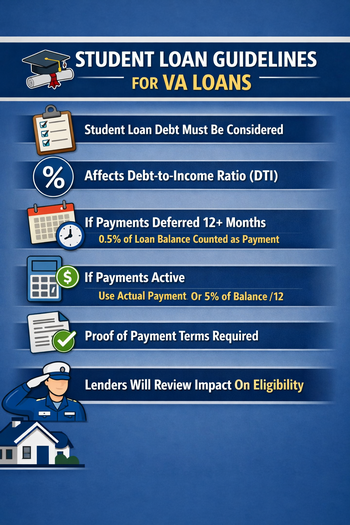 Student loans are a common obstacle to home loan approval, especially for borrowers with debt. The main takeaway is that VA lenders can count student loans in ways that raise your debt-to-income ratio, sometimes reducing how much you can borrow or blocking approval. For anyone carrying student debt, understanding how VA lenders calculate it is essential. It is equally important to know which strategies can improve the outcome.
How Student Loans Count Toward DTI
When lenders calculate your debt-to-income ratio, student loans receive the same treatment as any other recurring obligation. They appear on your ledger regardless of whether you are actively making payments or enjoying a temporary pause. The math does not distinguish between active repayment and suspended status.
Actual vs. Calculated Payments
This is where the process becomes more complicated. Lenders often do not use your actual monthly student loan payment. Instead, they use a calculated figure based on your outstanding principal balance, which is the main detail borrowers need to understand.
If You're Making Payments
Borrowers who are actively repaying their student loans will typically see their actual monthly payment used in the DTI calculation. This provides clear terms. A $350 monthly payment translates directly into $350 counted against your debt ratio.
If You're in Deferment or Forbearance
Deferment and forbearance offer temporary relief, yet they do not exempt you from DTI scrutiny. Lenders still assign a payment amount even when your loans are paused. They project what your payment would become once repayment status resumes, which leads into the standard calculation used next.
The 1% Rule (Most Important)
Most VA lenders use a standardized calculation known as the 1% rule. The key takeaway is that this method counts one percent of your outstanding student loan balance as your monthly obligation.
Example: A borrower with $40,000 in student loans would have $400 counted toward their DTI ($40,000 multiplied by 0.01). This figure applies regardless of what the borrower actually pays each month.
If your actual payment is $200 but your balance sits at $40,000, lenders use $400.
If your actual payment is $500 but your balance remains $40,000, lenders still use $400.
This is critical: Even with an income-driven repayment plan demanding only $50 per month, lenders might still assign $400 based on the balance calculation.
Why the 1% Rule?
This standardized approach assumes a 10-year standard repayment period. The main point is that the calculation gives lenders protection against underestimating your future obligations. If your repayment plan changes, the lender has already counted a larger monthly commitment.
Student Loan Balance vs. Payment: The Critical Distinction
This is the key distinction: borrowers often confuse balance with payment. The main takeaway is that lenders care about the number they count in DTI, not just what you actually pay each month. Let us clarify the mechanics.
Example 1: Large Balance, Small Payment
Consider a borrower with $60,000 in student loans enrolled in an income-driven repayment plan. Their actual monthly payment is $150.
What you might think: "My student loan payment is only $150 per month, so that should count toward my DTI."
What the lender does: Uses 1% of the balance: $60,000 multiplied by 0.01 equals $600 per month.
The difference: Lenders count $600 rather than your actual $150 payment. This $450 discrepancy damages your DTI considerably.
Example 2: Small Balance, Actual Payment Higher Than 1%
Now examine a borrower with $25,000 in student loans and a $275 actual monthly payment.
1% calculation: $25,000 multiplied by 0.01 equals $250 per month.
What the lender uses: The lender compares the actual payment of $275 against the 1% calculation of $250. They select the higher amount: $275 per month.
Result: Your actual payment exceeds 1%, so they use your actual payment.
The Rule in Practice
Lenders consistently choose the larger of the two figures: your actual monthly payment or 1% of your outstanding balance. The main takeaway is that the higher amount is what affects your DTI.
Payment = MAX(Actual monthly payment, 1% of outstanding balance)
Impact on Borrowing Power
Student loans can significantly reduce your borrowing capacity. The main takeaway is that even one student loan payment can change how much mortgage you qualify for. The following scenarios illustrate the effect.
Scenario: No Student Loans
Gross monthly income: $6,000
DTI limit: 41%
Maximum monthly debt: $2,460
Current debts: $600 (car loan)
Available for mortgage: $1,860
At 6.5% interest: ~$305,000 borrowing power
Scenario: Same Person with $50,000 Student Loans
Gross monthly income: $6,000
DTI limit: 41%
Maximum monthly debt: $2,460
Current debts: $600 (car loan) + $500 (student loans at 1% of $50,000)
Available for mortgage: $1,360
At 6.5% interest: ~$223,000 borrowing power
The difference: Student loans reduced borrowing power by $82,000, representing a 27% reduction.
Real Impact with Large Student Loan Balance
Gross monthly income: $5,000
Current debts: $300 (car) + $600 (student loans at 1% of $60,000)
Total debts: $900
DTI at 41%: Maximum debt = $2,050
Available for mortgage: $1,150
At 6.5% interest: ~$188,000 borrowing power
Without student loans, this person could borrow roughly $275,000. With $60,000 in student loans, borrowing power drops to $188,000. This $87,000 reduction represents a 32% decrease.
Student Loan Payment Scenarios
Different student loan situations lead to different counting methods. The main takeaway is that each scenario affects your DTI differently. The following breakdown shows how.
Scenario 1: Standard Repayment Plan, Making Payments
Balance: $35,000
Actual monthly payment: $360
1% calculation: $35,000 multiplied by 0.01 equals $350
DTI calculation: Uses $360 (actual payment exceeds 1%)
Scenario 2: Income-Driven Repayment Plan, Low Payment
Balance: $80,000
Actual monthly payment: $200 (PAYE or INCOME-BASED plan)
1% calculation: $80,000 multiplied by 0.01 equals $800
DTI calculation: Uses $800 (1% of balance far exceeds actual $200 payment)
Note: This scenario inflicts the most pain on borrowers. You pay $200 while lenders count $800.
Scenario 3: Deferred or Forbearance, Not Making Payments
Balance: $50,000
Actual monthly payment: $0 (in deferment)
1% calculation: $50,000 multiplied by 0.01 equals $500
DTI calculation: Uses $500 (lenders count a payment despite your current non-payment)
Scenario 4: Nearly Paid Off
Balance: $8,000
Actual monthly payment: $250
1% calculation: $8,000 multiplied by 0.01 equals $80
DTI calculation: Uses $250 (actual payment exceeds 1% by a wide margin)
Strategies to Improve Approval with Student Loans
Strategy 1: Pay Down Student Loan Balance (Most Impactful)
This approach offers the greatest return on effort. Reducing your balance directly lowers the 1% calculation.
Example impact: Paying off $10,000 in student loans reduces the calculated payment by $100 per month. This improves your DTI by 1.7% assuming a $6,000 income.
Timeline: 1 to 6 months depending on your payment aggression.
When to do it: Prior to applying for a mortgage. Even three to six months of aggressive repayment yields benefits.
Strategy 2: Increase Your Income
Higher income expands the DTI denominator without altering the student loan payment figure. That makes income growth another useful way to improve approval.
Impact: Each additional $1,000 in monthly income improves DTI by 3.3% (assuming a 41% DTI limit).
Timeline: Immediate with a new position; gradual with salary increases.
Strategy 3: Pay Off Other Debts
Credit cards, car loans, and other obligations consume DTI capacity. Eliminating these frees space for your mortgage.
Example: Paying off a $400 monthly car loan releases $400 of debt capacity.
Timeline: Varies based on remaining balances.
Strategy 4: Request Income-Driven Repayment Plan (Limited Help)
Switching from standard repayment to an income-driven plan reduces your actual payment. The main takeaway is that the 1% rule limits the benefit, since lenders may still use that percentage in your DTI calculation.
Scenario: You pay $500 monthly on standard repayment for a $50,000 balance. Switching to PAYE lowers your actual payment to $250. Lenders still count $500 (1% of $50,000).
Benefit: Minimal improvement to your DTI.
Strategy 5: Wait and Build Strong Compensating Factors
When student loan debt blocks approval, consider waiting six to twelve months. Use this period to build excellent credit, accumulate savings, and demonstrate stable employment. These efforts strengthen your overall financial profile.
This combined approach strengthens your overall financial profile.
Strategy 6: Lower Your Target Loan Amount
Requesting a smaller mortgage reduces your monthly payment and frees DTI capacity for student loans.
Example: Choosing a $300,000 home instead of a $350,000 home lowers your payment and improves your DTI.
Federal Student Loan Forgiveness and VA Loans
Public Service Loan Forgiveness (PSLF)
Pursuing PSLF does not aid your VA loan approval. Lenders count the full 1% of your balance regardless of any forgiveness plans you may be following.
Income-Driven Repayment Forgiveness
Income-driven plans offering forgiveness after 20 to 25 years still trigger the 1% rule. Lenders ignore the forgiveness benefit when calculating your DTI.
Student Loan Consolidation Considerations
Should You Consolidate Before Applying?
Consolidating federal loans into a Direct Consolidation Loan does not alter the lender's calculation method. The 1% rule still applies to the new consolidated balance.
However: If consolidation reduces your actual monthly payment below 1% of the new consolidated balance, some benefit may emerge.
Private Consolidation Loans
Some borrowers consider private consolidation to lower payments. This strategy carries risk because you forfeit federal protections such as deferment, forbearance, and forgiveness options.
Recommendation: Avoid consolidation solely for mortgage approval. Prioritize balance reduction instead.
Student Loans Still in School
Borrowers still enrolled in school face unique considerations.
- In-school loans count toward DTI
- Your actual payment or 1% of balance (whichever is higher) applies
- Deferred payments still generate estimated counts
If you are about to graduate or return to school after obtaining a mortgage, disclose this information to your lender. It may influence your approval.
Student Loan Payment Plans and Mortgage Approval
Income-Driven Repayment Plans (PAYE, INCOME-BASED, etc.)
Benefit: Lowers your actual monthly payment
Drawback: Lenders still apply the 1% rule, which typically exceeds your actual payment
Net effect: Minimal improvement to mortgage approval
Standard Repayment Plan (10 Years)
Higher monthly payments may align closely with the 1% calculation
Extended Repayment Plan (20-25 Years)
Lower monthly payments but the 1% calculation likely remains higher
Real-World Impact Example
Situation: A teacher earning $55,000 annually ($4,583 monthly gross) carries $80,000 in federal student loans under a PAYE plan.
Student loans:
- Balance: $80,000
- Actual monthly payment (PAYE): $180
- 1% calculation: $80,000 multiplied by 0.01 equals $800 per month
- DTI calculation: $800 per month (not the actual $180)
Other debts:
- Car loan: $300 per month
- Credit card: $100 per month
- Total debts: $1,200 per month
DTI calculation:
- Maximum DTI at 41%: $4,583 multiplied by 0.41 equals $1,879
- Current debts: $1,200
- Available for mortgage: $679 per month
- At 6.5% interest: ~$111,000 borrowing power
Problem: A $55,000 salary with only $111,000 in borrowing power restricts home buying options considerably.
Solution: Pay down student loans
Paying off $30,000 in student loans changes the picture:
- New balance: $50,000
- New 1% calculation: $500 per month
- New total debts: $900 per month
- Available for mortgage: $979 per month
- New borrowing power: ~$160,000
Paying off $30,000 in loans increases borrowing power by $49,000, a 44% improvement.
Key Takeaways
- Student loans count toward DTI. These obligations remain mandatory in the calculation.
- Lenders use 1% of balance, not your actual payment. Income-driven repayment borrowers face particular vulnerability.
- The 1% rule can hurt in low-payment situations. Paying $200 on a $60,000 balance triggers a $600 count.
- Student loans can reduce borrowing power significantly. Reductions of 25% to 35% occur frequently with high balances.
- Paying down balance is the most effective strategy. Each $10,000 paid reduces DTI by roughly $100 per month.
- Income-driven repayment plans don't necessarily help. The 1% calculation persists regardless of your plan.
- Deferred or forbearance loans still count. Lenders assign estimated payments even during non-payment periods.
- Increasing income helps. Each additional $1,000 monthly improves DTI by about 3.3%.
- Consolidation doesn't change the calculation. Lenders continue using 1% of the consolidated balance.
- Plan ahead if possible. Consider aggressive student loan paydown six to twelve months before applying for a mortgage.
Bottom Line
Student loans represent a formidable factor in VA loan approval and borrowing capacity. The 1% rule ensures that even minimal payments offer little assistance. Lenders count a full percentage of your balance regardless of your actual contribution. Borrowers with substantial student debt should prioritize reducing their balances before submitting a mortgage application. Even modest progress, such as paying off $10,000 to $20,000, can meaningfully improve approval odds and borrowing power. When immediate paydown proves impossible, focus on increasing income and eliminating other debts to improve your overall DTI ratio.
What student loan payment do VA lenders use for DTI?
VA lenders use whichever amount is higher: your actual monthly student loan payment or 1% of your outstanding balance. This means borrowers on income-driven repayment plans with low payments often have a much higher amount counted against their DTI.
Does student loan deferment help with VA loan approval?
No. Lenders still count a payment even when loans are in deferment or forbearance. They calculate what your payment would be if you were in repayment status, typically using the 1% rule.
Can I exclude my spouse's student loans from my VA loan application?
In community property states, your spouse's debts may be counted even if they are not on the loan. In other states, only debts in your name count. However, if your spouse is applying with you, their student loans will be included regardless.
Does Public Service Loan Forgiveness help with VA loan approval?
No. Lenders do not consider PSLF when calculating your DTI. They count the full 1% of your balance regardless of forgiveness plans or timelines.
How much does paying off student loans increase borrowing power?
Each $10,000 paid off reduces your monthly DTI calculation by $100. For a borrower with a $6,000 monthly income, this improves DTI by approximately 1.7% and can increase borrowing power by $15,000 to $20,000 depending on interest rates.
Connect With Us
Please share – it really helps